“The Four Types of Overload: Cognitive, Emotional, Physical & Stimulation — And How They Impact Your Wellbeing”
A practical guide to understanding the four types of overload that drain your energy, focus and resilience.
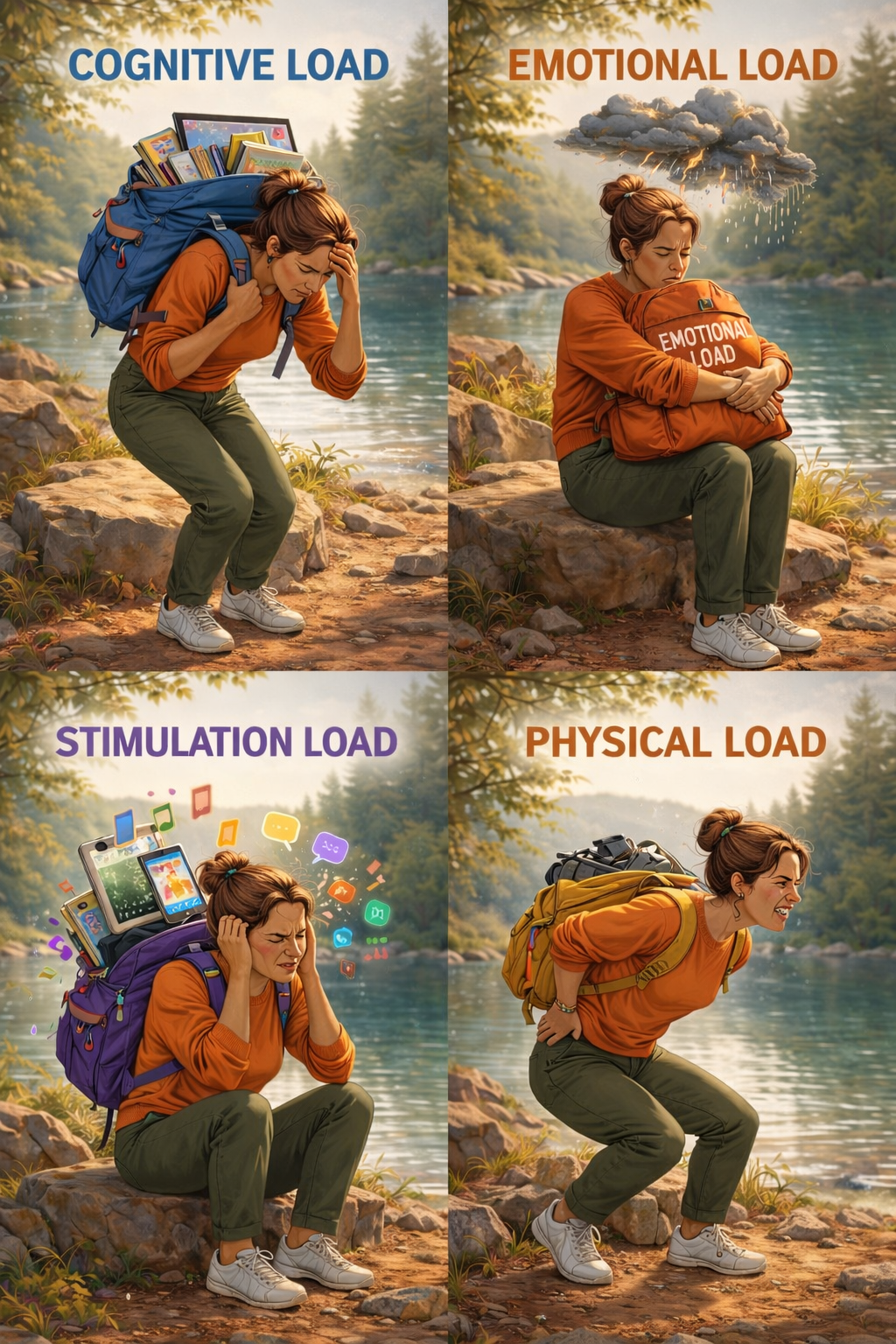
Lay down your Loads and see what happens........
We all carry so much these days, Our brains 🧠 are full and overloaded with our everyday busyness!
The loads we all carry are all different but we can pop them into a few categories, I didn't come up with these they are all discussed and have been thought of by various field leaders in Psychology and neuroscience.
🧠 The Emotional load
🧠 The Cognitive load
👀 The Stimulation load
💪 The Physical load
I've been reflecting on these this week while on holiday, and about all that we carry daily and what happens when we take a break.
When we step away from work, putting things down can feel difficult. I can tell when my clients are heading off on holiday, and I am sure you can tell when your boss or colleagues are going off too, and not just because they tell you!
But when we step back and rest what actually happens?
We put all the noise in our heads aside and allow our brains 🧠 the time to sort through it all.
It takes a little time to relax, shut the thoughts off, and everything slows down.
What is happening is we go from Doing to Being mode. Creativity increases as Cortisol drops (the stress chemical) and we go from one state or level of stress to another.
Often people become ill or very tired as the immune system shifts from high alert to calm as stress leaves the body.
We can't keep going 100 miles an hour and only resting on holiday.
When returning to work after a holiday, take a little time to reflect on how you can take a daily holiday to keep those Cortisol levels down.
Can you find a way to take a proper break, have a walk, relax or meditate during the day.
Don't pick up all that you carry all at once. Find a way to put all the mental loads down to keep from burning out.
We have to recognise that we live in a world that is so fast paced that we must find a way of Being in our everyday of Doing.
No 1 - The Cognitive Load we carry
The way I would describe it is the amount of processing your brain can handle at a time, a bit like how much your computer can do all at the same time without going slowly and crashing! (I am after all a computer nurd)
How many programmes can be running and keep going. We all know the analogy about spinning plates or juggling too many things at once.
John Sweller came up with the Cognitive Load Theory in the 80's, and it is widely used to look at how we learn, how we perform and how productive we are.
For me, I am thinking about this in the sense of how much we hold in our heads all the time.
❓ Where the kids are, what after school clubs they have, the meetings we have during the day, the appointments at the end of the week. The calls we need to make, the emails we need to respond to, the difficult conversation we need to have, the projects we are managing etc...
Decision fatigue, what's for dinner? what to do next?
I think you get the picture.
We have so many things going on in our lives that we cannot possibly hold everything in our heads at once and expect to be able to concentrate on work 100%. Our brains find it difficult to stay focused when we have so much stuff that it must not forget!
We hold all these things and many more in our heads day and night, no wonder so many people are overwhelmed.
Your brain try's to keep all this in the conscious part of your brain. When we rest our subconscious thoughts can come through, but 1st we need to quieten the noise of all this we are processing!
5 things that may help manage your Cognitive Load if you are feeling overwhelmed.
🧠 Externalise the brain. A few ideas.
Write lists (you probably already do this) boards, notes, anything that gets thoughts out of your head. Have 1 method not 10.
🧠 Reduce decision making. Routines, defaults, templates, and “good enough” choices. Make life easy for yourself.
📖 Chunking. Grouping tasks into themes to reduce having to jump back and forward between things.
🔝 Prioritisation rituals. Daily or weekly “what actually matters” resets.
🌞 Daily Holiday. Intentional pauses where the brain is not required to do anything at all. Go for a walk
No 2 - The Emotional Load we carry
The idea of this comes from research in emotional regulation from the work of Arlie Russell Hochschild.
Her research shows that humans carry a measurable “load” when they must regulate, suppress, or perform emotions. When the emotions someone feels do not match the emotions they’re expected to show, this she talks about as emotional labour.
More recently I think we would see this as masking, putting on an act, covering up how you actually feel.
So many "Hide" their true feelings and this leads to feeling exhausted, and in many can lead to burnout as it is unsustainable.
So many people answer the question "How are you" with "I'm fine" an auto response but many cover up so much more and this I know leads to burnout, emotional deregulation and emotional dissonance.
Simply put, trying to be someone else and cover up who you really are especially in work takes it's toll, the feelings we are holding, suppressing and navigating all contribute to the emotional load we all carry.
Just a note, the emotional load can also be affected by the emotional draining power of others who are negative or do not align with us, so it is not always about covering up or suppressing your own emotions, it might be that you have to deal as a leader with others you find difficult.
So what can we do about it?
Here are 5 tips that may assist.
🧠Name the emotion you are feeling. Frustration, sad, angry etc..
Labelling reduces intensity and increases agency. Acknowledge how you feel and in time you can share this with someone else to reduce it's hold even more
🧠Micro‑processing
Take 2–3 minutes to pause when an emotion comes up, to really feel it, breathe, and release. let it go, put it down
🧠Emotional boundaries
Notice who's emotion it is, is it yours or are you absorbing someone else's emotions and mirroring them
🌞Co-regulation
Connecting with the right people. Talk to someone, go for a walk with someone, share how you actually feel with someone you trust
💃 Be Creative
Do something you love, moving can release the stress of holding an emotion at bay. Dancing, singing, journaling your thoughts, voice notes being creative in anyway that you enjoy.
No 3 - The Stimulation Load (Overload) we carry
This is most definitely a newer subject and something that previously we weren’t dealing with, this idea is new and become so much bigger because it is made worse with the digital age in which we find ourselves.
We have sensory, digital, environmental, and social input hitting our nervous systems on a continual basis.
As adults we don't know how to deal with this, for our younger generations they have never known anything else! this is another subject but it is not helping them in the slightest!
Simply put we are bombarded with information 24 hours a day from every angle. Let’s face it there is an App for everything and although the tools at our fingertips are there to assist us and they are great, together they create a Nosie that was previously non-existent.
The science is still emerging around this and will continue as we understand the neuroscience of attention, overstimulation from digital tech and the links with dopamine hits, attention fatigue and the impact all these new things have on and affect our nervous system regulation.
The helpful tips I offer here, seem simple but that dopamine hit we seek when a notification goes off on our phones, the number of times we check emails, the feelings we get when we get a like or a comment on a social media post. OR not! Make it harder to lay down the Stimulation Load than we think.
5 ways to help your nervous system
📢 Reduce sensory clutter
Sound, light, visual noise, notifications
🧠Single‑tasking
Multi tasking feels great but it is not as productive as doing 1 thing at a time well
🕰️ Digital boundaries
App limits, phone in another room, intentional screen breaks
⛰️ Nature immersion
Just spending 5 minutes outside can recalibrate the sensory system
🍴 Stimulation fasting
Short periods of intentional quiet, stillness, or low input. You can even get lockable boxes to put your phone in.
Give yourself the space, the quiet, the time to just be.
Get bored, allow yourself the space to just be with no stimulation at all. If you can’t find a quiet place, put earphones in. Shut the world out and see how your mind adjusts and let it just be for a while.
No 4 The Physical Load
I am reminded of the story about the professor who asks his class how heavy a glass of water is.
The students give him different measurements of weight, he then asks how long can you hold the glass. The professor wanted to illustrate that it didn’t matter how heavy the glass was, it was all about the fact that we cannot hold it indefinitely as it becomes heavier over time. This is stress.
When I think about physical load, I think about energy, fatigue, tension and the stress our bodies are under. The “Just keep Going” “Just get through it” world we live in. Don't show weakness! Don't give into the stress.
So, what are you doing to your body?
Are you sleeping well or staying up late?
Are you fuelling yourself correctly or are you missing meals and getting by on coffee and sweet things?
Are you moving your body at all or are you exercising too much?
Are you running on empty?
5 tips to help you manage your physical load
🕰️ Restorative rest
Not just sleep, but micro-rest, lying down, stillness
🚶♂️➡️ Movement that releases, not depletes
Stretching, walking, shaking, mobility
🧘♀️ Stress management techniques
Breathwork, long exhales, grounding, meditation, mindfulness
🍎 Nutrition and hydration
Stabilising energy rather than spiking it
🫁 Body scanning
Notice where in your body you are holding your stress and relax that specific part
My final thought on the physical load we carry, is that we only have one body. If you were given a car on the day you were born and told that you have to look after it because it is the only one you will ever have in your lifetime, how would you treat that car? Would you take care of it, you can't have another one!
We only have one body, and it gives us signals all the time about what it needs.
Listen to your body, what does it need?
These are the 4 Loads we all carry, each one takes it toll on our wellbeing. Each one slightly differernt and weighs us down differently at differernt times depending on what is going on.
One thing though is clear. To live a happy and healthy life we have to take care not to try to carry too much at once.
Notice what you are carrying, what is too heavy and lighten your load.
If you need help exploring these loads then book a call in and let me take some of the weight off your shoulders.